Find the small water line near the furnace or air handler. If it reaches a box attached to the sheet-metal duct, the box may be a humidifier. A humidity control, called a humidistat, compares the measured humidity with its setting. When moisture is needed and the operating conditions are met, the system adds water vapor to the moving air.
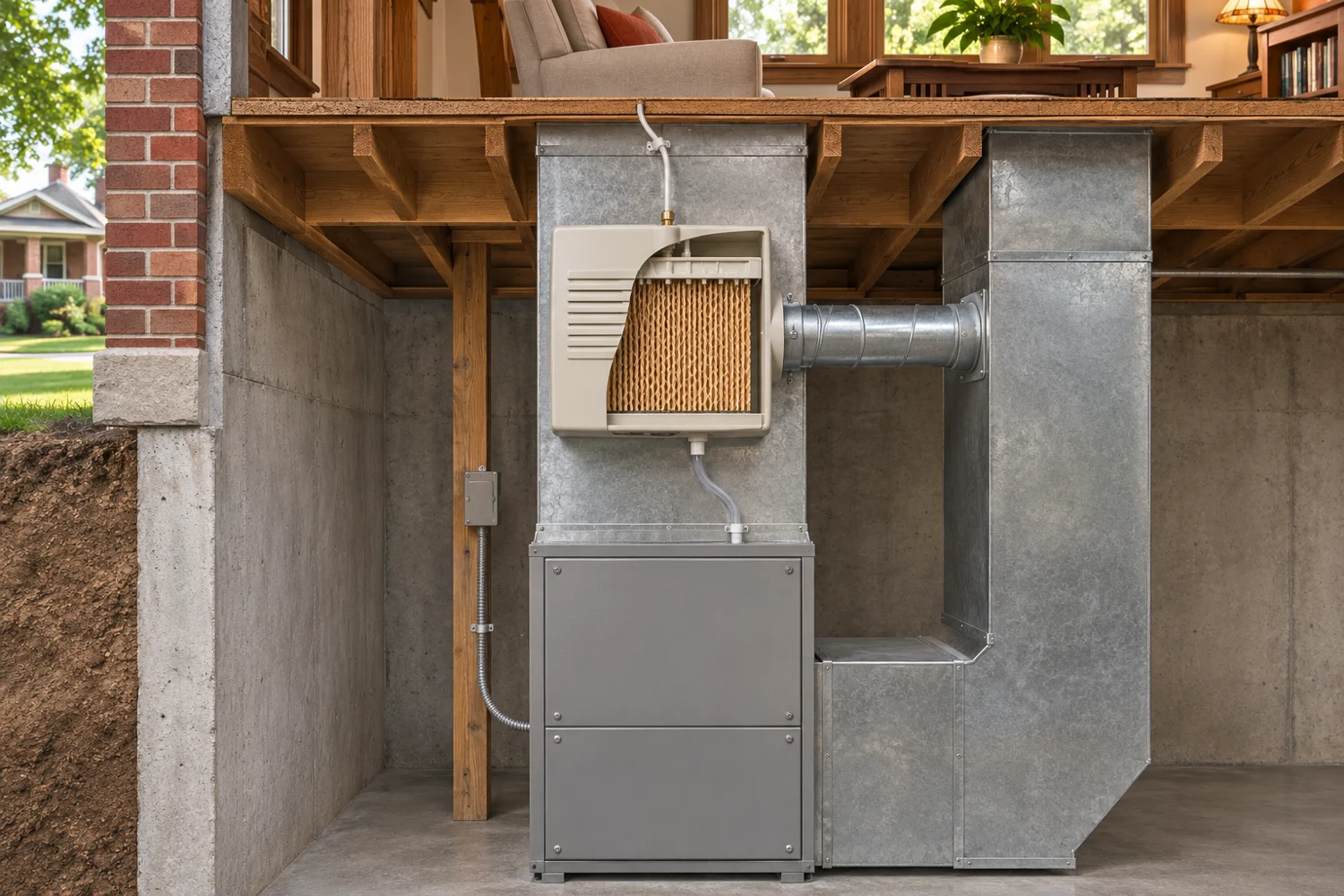
Evaporative system · Air picks up moisture as it passes through a wet panel. The furnace blower carries it to the rooms.
Identify the hardware beside your duct
Bypass evaporative
Look for a short round duct joining the supply and return sides. The pressure difference created by the blower moves air through a wetted panel. On a flow-through design, surplus water rinses minerals toward a drain. A seasonal damper may be manual or automatic.
Good question for a bid. Is there room for the bypass duct, and will the heat source and winter blower schedule provide enough evaporation?
Fan-powered evaporative
A small fan in the cabinet draws duct air across a wet panel and returns it to the duct. This design can fit where there is no practical route for a bypass duct. The central blower still distributes moisture through the house.
Good question for a bid. What output should I expect at my system’s normal supply-air temperature, and where can the panel be removed for service?
Steam
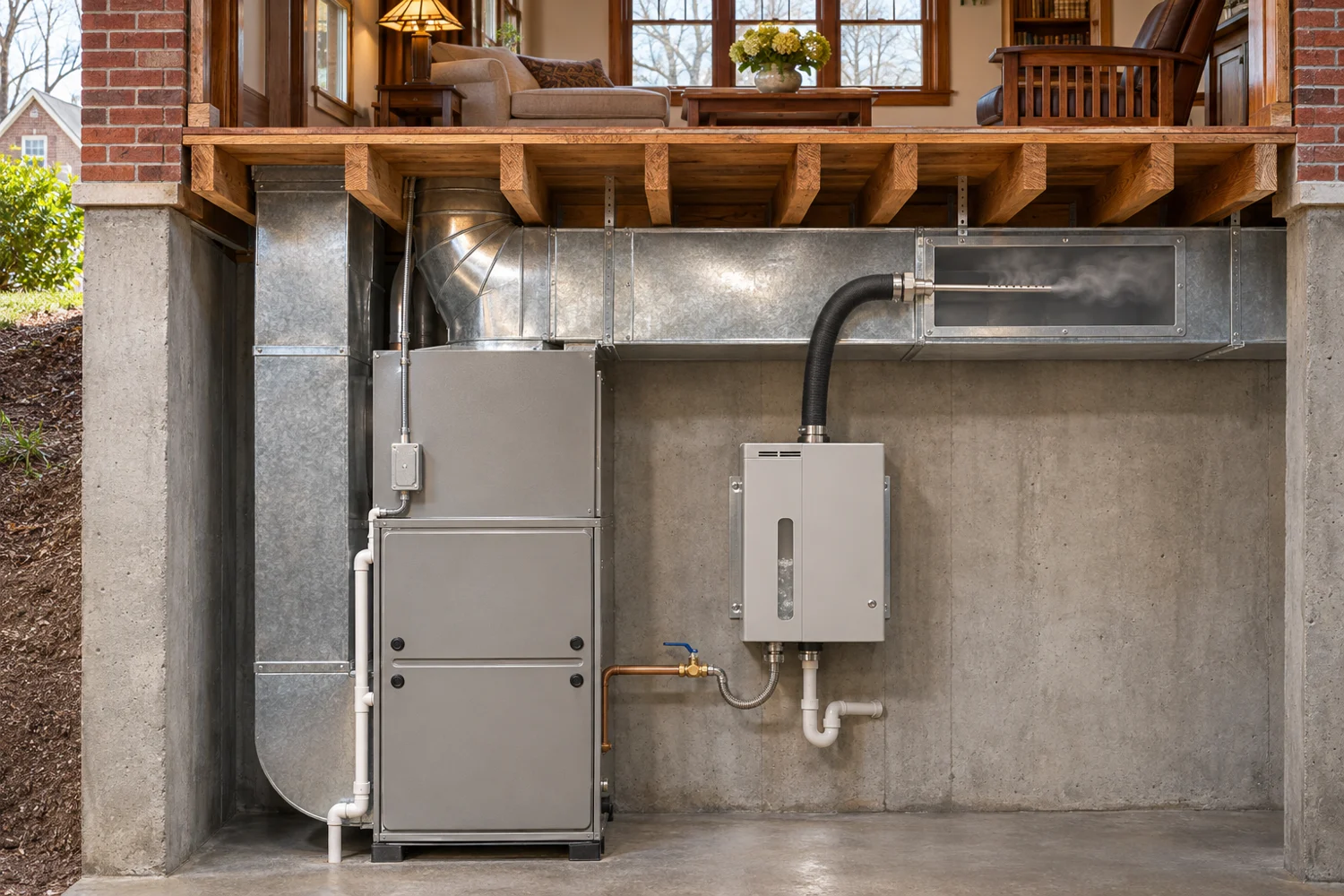
Look for a separate cabinet connected by a steam hose to a dispersion tube in the duct. An electrode canister or resistive heater boils water. A properly configured control can call for blower operation even when the furnace is between heating cycles.
Good question for a bid. How much electrical power does this model draw, what water quality does it need, and is there enough downstream duct length for the steam to be absorbed?
Reservoir and rotating drum
A motor turns a porous drum through a pan of water. A float maintains the water level as air passes across the wet drum. Some older bypass units use this arrangement, so the round bypass duct alone cannot identify the water system.
Good question at move-in. Where is the owner’s manual, when were the pan and media last cleaned, and does the float stop the incoming water at the proper level?
Steam system · The cabinet makes the vapor. The duct needs moving air and room downstream of the dispersion tube for that vapor to mix.
Set humidity for the house and the weather
Take a relative-humidity reading in an occupied room away from a supply register, shower or cooking steam. Record the temperature and RH together. Cold outdoor air brought inside and warmed can have low relative humidity even on a damp winter day. Air leakage affects how much moisture a house needs.
A St. Louis cold front is coming. What changes?
Cold glass can collect water even when a room feels comfortable. EPA’s general indoor goal is 30–50% RH when feasible and below 60%. A cold window may need a lower winter setting. For example, one AprilAire manual suggests 35% at 20°F outdoors and 25% at 0°F. Use your model’s guidance and the first signs of condensation to fine-tune your setting.
With manual control, check the forecast before a sharp temperature drop. An outdoor-sensing automatic control can lower the target as outdoor temperatures fall. Check the coldest window the next morning. Persistent droplets, frost or wet woodwork call for less humidification and attention to the moisture source.
The room still feels dry. What should I check first?
Compare the control reading with a separate meter in the room. Note the outside temperature, whether the blower runs and whether the humidistat is calling. For a bypass unit, check the external seasonal damper position against its markings. For steam, note the service indicator. A technician can then distinguish a depleted panel, restricted water feed or airflow issue from a home losing humidified air rapidly.
What if I see water at the furnace?
Some flow-through models discharge water into a drain while operating. Water collecting under the cabinet, on wiring or inside ductwork needs investigation. Turn humidification off at the normal control if it is safe to reach, keep away from wet electrical equipment and arrange service. Steam hoses, canisters and drain water can be hot.
What changes from one heating season to the next?
Before the first heating cycle
Locate the model number, water shutoff, control and drain. Check the manufacturer’s schedule for the evaporative panel, drum cleaning or steam canister. Mineral buildup varies with water and runtime. Follow the model’s shutdown and isolation procedure for any owner-serviceable part. Have a technician handle electrical work, steam plumbing and internal leaks.
During winter
Look for moisture at windows, drain backups and leaks below the cabinet. Record room RH and any service alerts. If a steam unit calls for canister service ahead of schedule, give the technician the code and describe your water treatment. Electrode models depend on water conductivity, so water-treatment advice is model-specific.
When cooling season arrives
Follow the manual’s shutdown procedure. Where the unit has a manual summer/winter damper, move it to the indicated summer position. Reservoir models may require draining and cleaning before storage for the season. Record the pad or canister number where the next homeowner can find it.
Compare two humidifier proposals
Bring both installers the same winter room readings, the coldest outdoor temperature in your log, your furnace or heat-pump model and a photo of the ductwork. Ask each to put the following in writing.
Capacity in your house. How did they account for floor area, ceiling height, air leakage, heating runtime and the desired indoor humidity? Catalog gallons per day describe specified test conditions.
Controls and airflow. When can the humidifier run, who controls the blower, and how will the system respond when only the smallest zone calls?
Water, energy and service. Where will water enter and drain? Include electrical work, pad or canister price, replacement interval, labor, and clearance to remove parts.
Handoff. Ask for a demonstrated call for humidity, verification of drainage and shutoff, a winter adjustment walkthrough, and the model-specific maintenance instructions.
Imagine smoke slipping in through an open door. Only the portion that reaches the return can pass through the central filter. Inside the cabinet, fibers or collector plates capture some particles. The blower sends the cleaned air back to the rooms, where it mixes with the air already there. Each pass takes time.
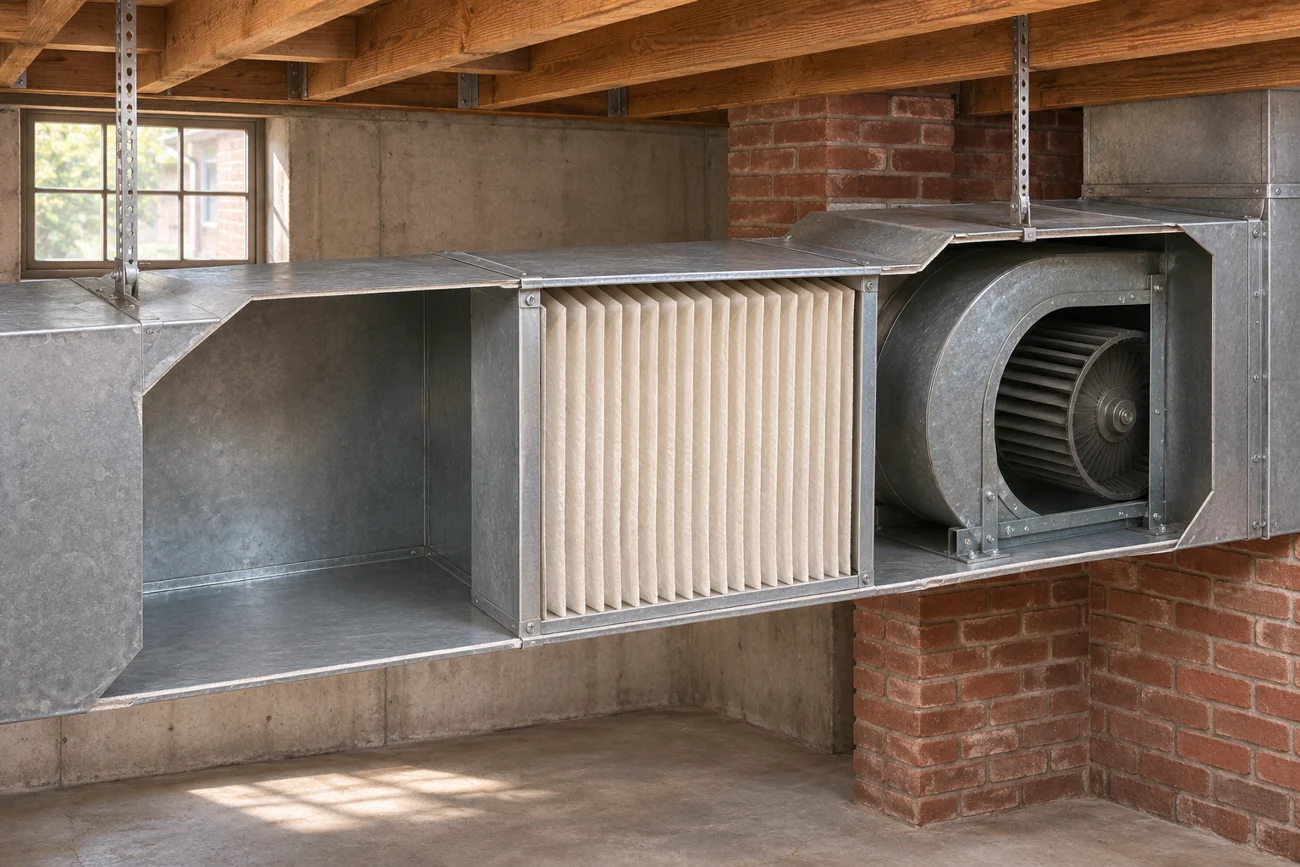
Passive media filters air whenever the blower moves it through the cabinet.
Start with the pollutant. Dust, pollen and smoke particles can be captured by particle media. Odors and gases need source control, clean-air ventilation or a sorbent selected for the gas. Moisture calls for a humidity or water-management response. A household filter provides no protection against a carbon monoxide emergency.
Passive filters and what they capture
“Passive” describes the filter material. The central blower or a portable cleaner’s fan still supplies the airflow. The word “electrostatic” on a package can describe charged fibers as well as powered equipment, so check whether the device has a power supply and a collector.
Flat and pleated media
A mat of fibers intercepts particles as return air passes through. Pleats fold more media into the available space. Some fibers carry a permanent electrostatic charge and still need no electrical connection.
At your house. Start here for airborne pollen, pet dander or smoke particles. Compare the MERV rating, exact fit and pressure drop at your system’s airflow. A washable mesh screen may catch lint while letting much finer particles through.
Deep media cabinet
A deeper cabinet can hold a filter with more pleat area. Spreading airflow across more material can reduce resistance at the same efficiency and allow more dust to accumulate before replacement.
At your house. Useful when a shallow rack makes a fine filter too restrictive. Have the contractor check the cabinet footprint and leave enough clearance to pull the entire cartridge out. Compare specific models at equal airflow.
Activated carbon and other sorbents
Gases attach to the internal surfaces of the media. Which gases it captures depends on the material, how much is present and how long air stays in contact. The media eventually fills.
At your house. For an odor concern, identify the source and ask which gas the cartridge was tested against. A thin carbon sheet and a deep carbon bed can have very different service lives. A particle MERV rating tells you nothing about gas removal.
HEPA media
HEPA describes high-efficiency particle capture by the filter material. Overall performance also depends on the volume of air the fan can push through the filter and whether air leaks around it.
At your house. A room cleaner pairs the filter with a fan designed for it. Central HEPA retrofits may use a separately powered bypass unit to clean part of the return airflow. Ask for delivered airflow before treating a bypass rating as whole-house performance.
Powered collectors, ionizers and UV
Open a proposal for an “electronic air cleaner” and look for the verb. Does it collect particles on a plate, send ions downstream, illuminate a coil, or react with gases? Each claim needs a different performance test.
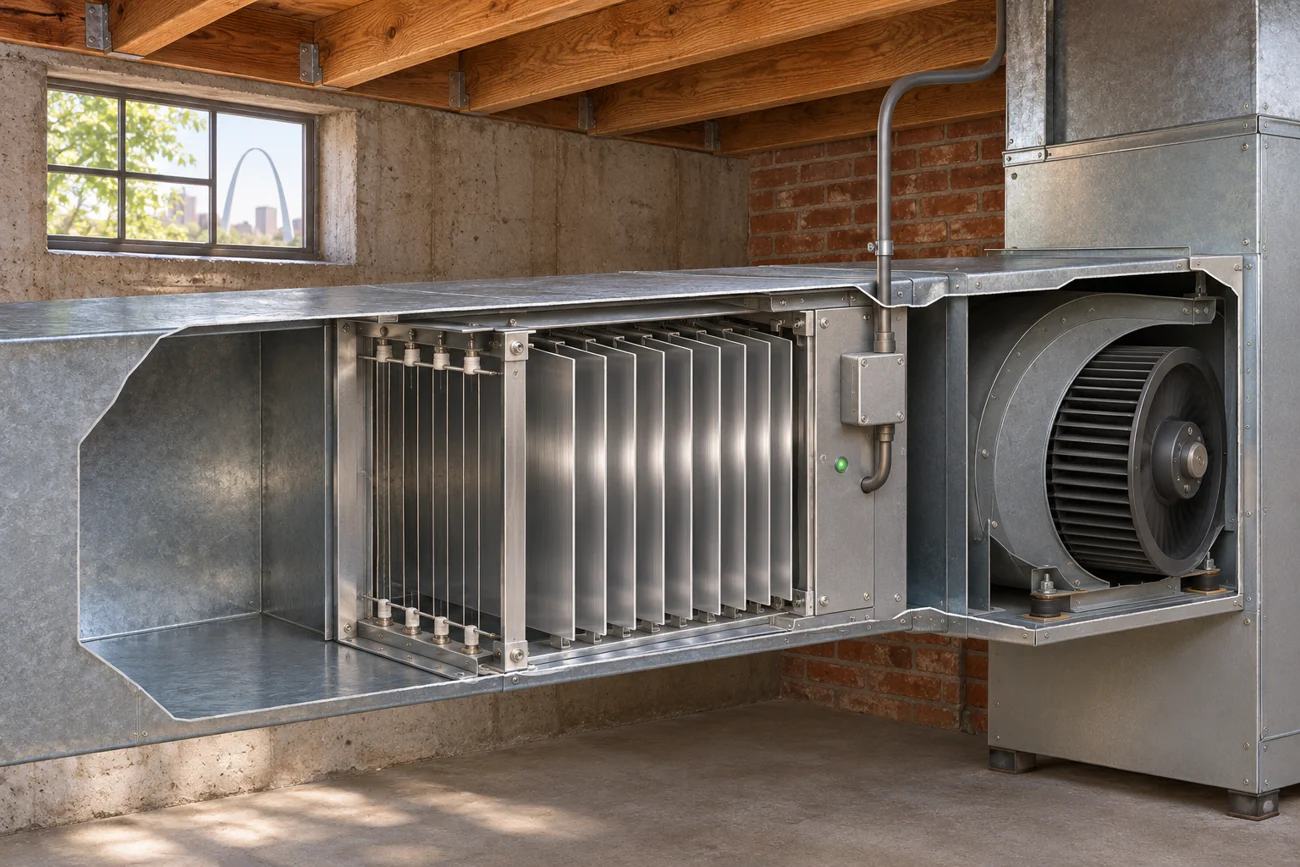
A powered collector gives charged particles a place to land. The cell needs regular cleaning.Electronic precipitator with collector plates
An ionizing section charges particles. A second section collects them on plates. Look for a power supply and a removable cell behind a service cover. Performance falls as the plates load up.
Before buying. Ask who cleans the cells, how they must dry before reuse, how a failed power supply is detected, and what independent ozone-emissions data are available. Follow the model’s shutdown and service instructions.
Ionizer, bipolar ionization or plasma
These devices release charged species into the airstream. Some charged particles can settle on walls or other surfaces. A collector or downstream filter changes where the particles end up.
Before buying. Ask for independently measured results on the target pollutant under realistic airflow and for byproduct testing. For bipolar ionization, EPA recommends UL 2998 certification if choosing this technology. That certification addresses ozone emissions; separate evidence is needed for the cleaning claim.
UV-C at a coil or in the airstream
A coil lamp illuminates a surface for long periods. An air-treatment system exposes passing organisms for a much shorter time. Germicidal dose depends on lamp intensity and exposure time. Neither application collects dust or smoke.
Before buying. Ask what surface or airstream is being treated, what dose reaches the target, and how aging lamps are replaced. Keep access covers closed. Direct exposure can injure eyes and skin.
Photocatalytic oxidation and ozone
Photocatalytic devices use light and a catalyst to react with gases. Incomplete reactions may produce other compounds. Ozone generators deliberately release a respiratory irritant.
Before buying. For a proposed oxidation system, ask what gases were tested and which byproducts were measured downstream. EPA advises against operating intentional ozone generators in occupied spaces.
Match filtration to the blower
Read MERV by particle size. Minimum Efficiency Reporting Value compares capture in a controlled test. A higher rating generally captures more of the smaller test particles. EPA recommends MERV 13 when the equipment and rack can handle it, or the highest compatible efficiency. MERV measures filter performance on a pass through the material. Room cleanup also depends on airflow, leakage around the frame and fan runtime.
Minimum average capture efficiency by tested particle size, from EPA’s MERV table
Filter
0.3–1 micron
1–3 microns
3–10 microns
MERV 8
No listed minimum
20%
70%
MERV 11
20%
65%
85%
MERV 13
50%
85%
90%
Why two filters with the same rating can behave differently
Pressure drop is the resistance air encounters crossing the filter. Thickness, pleat area and construction affect it. Ask for pressure drop in inches of water column at your actual airflow in cubic feet per minute (CFM). Comparing two published values at different CFM can give a misleading result.
What the technician should measure
Ask for pressure drop across the filter and total external static pressure for the system. Have the technician compare the measurements with the equipment’s fan performance data and verify delivered airflow. Ask how much resistance the system can tolerate as the filter loads up, and when it should be changed.
What to check at the next filter change
Record the exact replacement model and dimensions printed on the old filter. Follow the equipment instructions for shutting the fan down. Check the airflow arrow, seat the filter in the intended track and close the cover. Gaps let air bypass the media. Adding a second filter in series adds resistance, so use the designed filter locations.
Does running the blower longer help?
More runtime gives the central filter more passes. It also uses electricity. Continuous fan operation during cooling can return moisture from a wet coil to the house. If the goal is one bedroom overnight, compare a quiet room cleaner with extending whole-house fan runtime.
Size a room cleaner by delivered clean air
Smoke CADR is the clean air delivery rate for smoke particles, normally listed in CFM in the United States. Look for a published rating at a known fan speed. Check the sound at the speed you expect to run while sleeping. The number on the box often comes from the highest setting.
A 12-by-15-foot bedroom. The floor area is 180 square feet. For a typical eight-foot ceiling, EPA’s smoke sizing rule gives a minimum smoke CADR of about 120 CFM (180 × ⅔). At that rating, the cleaner supplies the equivalent of five room volumes of clean air per hour: 120 × 60 ÷ 1,440. Actual particle levels also depend on mixing, open doors and new smoke entering.
A taller ceiling or an open doorway to a living area adds air volume. Size for the connected space you intend to clean, leave room around the intake and discharge, and check the ongoing cost of filters. A smoke CADR rating measures particles. For gases, ask for separate performance data.
Size a portable cleaner for one room
Compare the smoke clean air delivery rate (CADR) on the product label with the size of your room. EPA’s rule of thumb is a smoke CADR of at least two-thirds of the floor area for an 8-foot ceiling. This estimate scales with volume for taller rooms.
Use the area connected by open doorways if you want the unit to serve that whole space. A closed bedroom door and a noisy high-speed setting can both change how much clean air reaches you overnight.
Keep smoke from entering where practical. Size a room cleaner by smoke CADR and run it at the highest speed you can sustain. A compatible central media filter can supplement it when the blower runs.
Dust settles again soon after cleaning
Look for tracks around the filter frame and for a loose rack cover. Settled dust on shelves also comes from material that never reaches a return. Fit, source control and surface cleaning matter alongside filter efficiency.
Cooking odor lingers
Use a range hood that exhausts outdoors when available. Particle media can catch grease and smoke particles. Gas-phase odor removal depends on the sorbent. A persistent odor deserves a search for its source.
A basement smells musty
Look for moisture entry, damp materials or drainage problems before buying equipment. A filter can capture some airborne spores. Correcting the water problem addresses the conditions that support growth.
A mini-split serves the room
The indoor head often has a washable screen and limited space for additional media. Check the exact manual. A correctly sized room cleaner adds fine-particle filtration without restricting the head’s airflow.
Compare two filtration bids
Give both bidders the same rooms, pollutant and equipment model. Request the proposed filter or device model, dimensions, rated efficiency, clean pressure drop at design airflow, intended runtime and expected sound. Ask each to price installation and a year of filters, cells or lamps separately.
For powered treatment, request independent performance and byproduct tests for the exact unit. At handoff, ask for measured airflow and pressure, the replacement part number, service access and a demonstration of the maintenance indicator. Keep those details with the HVAC manual.