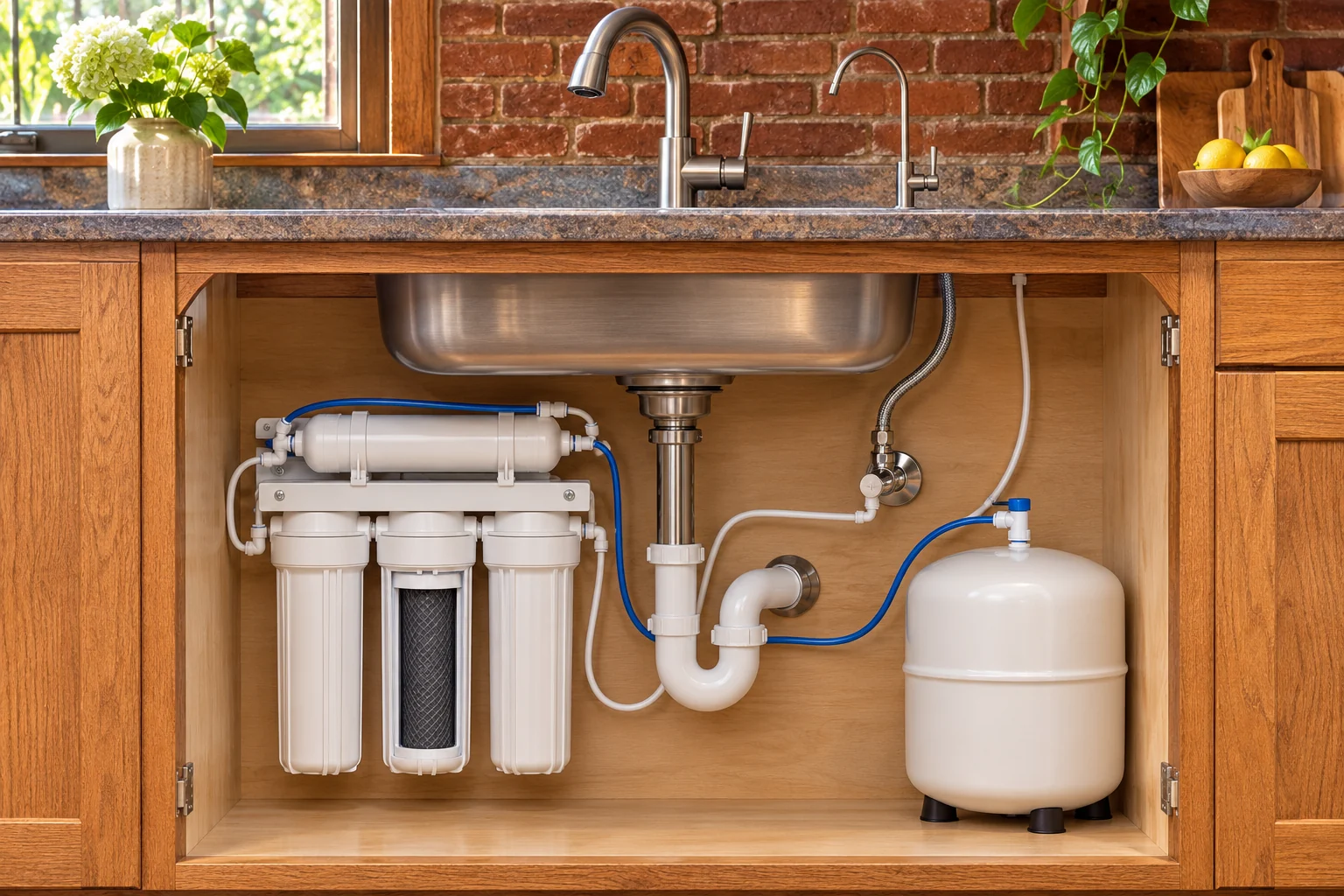
Under the sink · Reverse osmosis with a storage tank
Start with your address
What do you want to change about the water?
For a chlorine taste in your glass, start at the tap where you drink. For grit at several fixtures, ask your supplier or plumber about the source before sizing a whole-house sediment filter. For lead, start with a tap sample through a certified laboratory. Lead can enter water from the service line or plumbing inside the house.
My supplier is different, or I have a private well
Use the utility name on your bill to find its annual water quality report. A utility report summarizes the system. A tap test can answer a question specific to your house. For a private well, CDC recommends annual testing for total coliform bacteria, nitrates, total dissolved solids and pH. Ask the local health department which additional tests fit your area.
Whole-house and under-sink describe locations. Carbon and reverse osmosis describe treatment methods. A single under-sink system can use both.
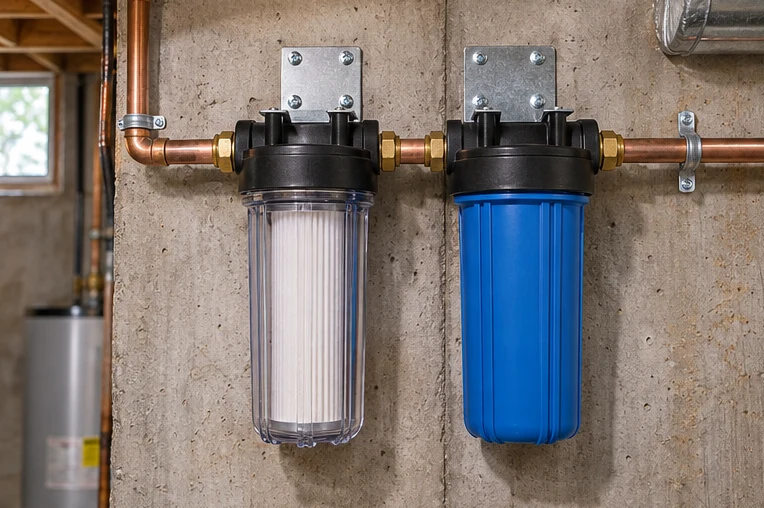
At the main water line
A point-of-entry filter serves the fixtures downstream of it. A sediment cartridge catches particles such as grit. A carbon tank or cartridge can reduce disinfectant taste and odor when rated for the disinfectant your supplier uses.
What to check before buying
Ask which fixtures bypass treatment, how much pressure the unit drops at peak flow, and how you will service it. Removing disinfectant at entry can allow more germs to grow in household plumbing.
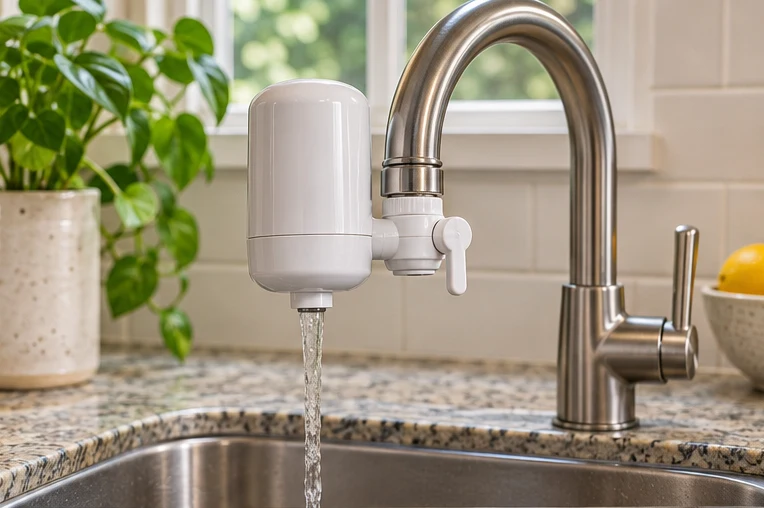
On the faucet or counter
A faucet-mounted unit lets you switch between filtered drinking water and ordinary tap water. A countertop unit may connect to a faucet diverter or use a refillable reservoir. This can suit a renter who wants more than a pitcher holds.
What to check before buying
Check the actual spout before buying. Pull-down spray heads may be incompatible with faucet adapters. Compare the time to fill a cooking pot and the counter space the system needs.
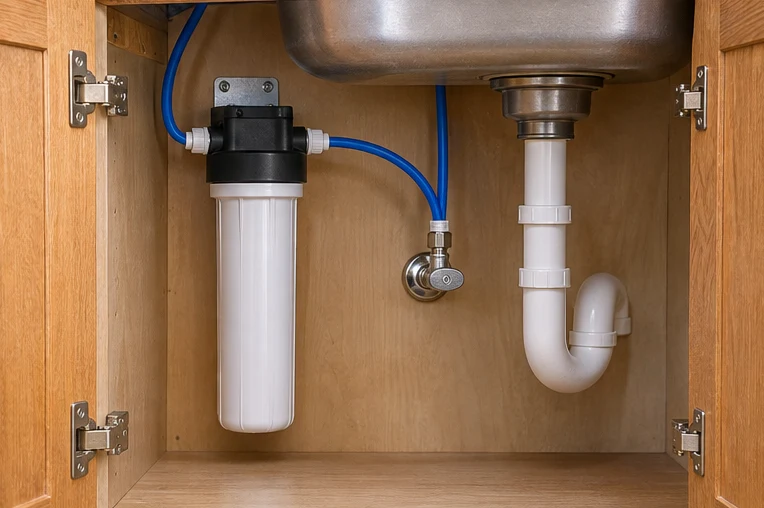
In the sink cabinet
A cold-water line feeds an under-sink cartridge. Some units supply the kitchen faucet and others use a separate drinking spout. In an activated-carbon element, selected substances cling to the porous carbon surface as water passes through.
What to check before buying
Compare rated flow and capacity for the exact claim you need. Measure space below the housing so you can remove the cartridge. For chloramine, look specifically for a chloramine reduction claim.
In a pitcher or dispenser
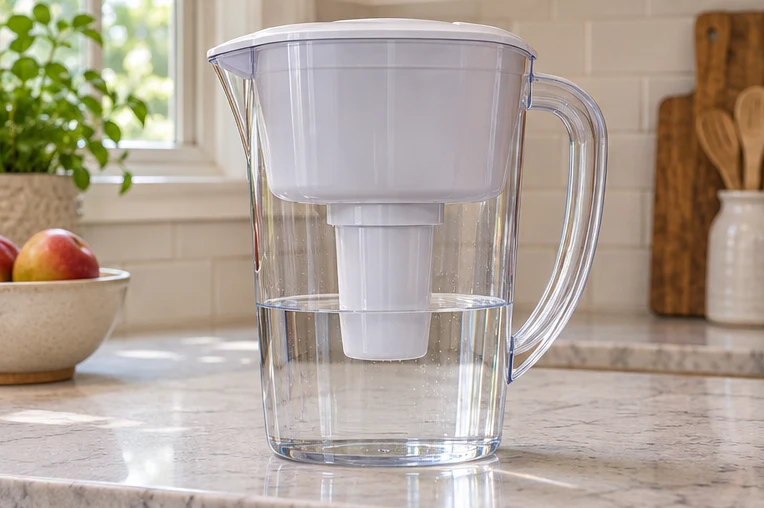
Gravity draws water from the upper reservoir through a cartridge into the lower chamber. You can try it without changing the plumbing. Choose the filtered reservoir size around the bottles or glasses you actually fill.
What to check before buying
Brita lists 40 gallons for its Original cartridge and 120 gallons for Elite. Elite also carries a lead-reduction claim. Match the cartridge and compatible pitcher to the performance sheet, then follow its time or gallon limit.
What about the refrigerator or ice maker?
A built-in cartridge typically treats water for the refrigerator dispenser and ice maker. The kitchen faucet has its own supply. Look up the refrigerator and filter model together, confirm the reduction claims and follow the flushing directions after a change.
See behind the cabinet door
Why does an RO system have a drain line?
Cold water feeds the prefilters. In a typical system, sediment filtration catches particles and carbon protects the membrane from chlorine. Water pressure then pushes part of the feed through a semipermeable membrane. Two streams leave that stage.
To your glass
Treated water collects in a pressure tank on a tank-style system. Opening the drinking faucet releases stored water, often through a final carbon filter. Tankless models produce water on demand. Compare dispensing flow, power needs and available cabinet space.
To the drain
The remaining stream carries concentrated dissolved substances away. EPA WaterSense labeled point-of-use systems send at most 2.3 gallons to the drain per gallon of treated water under test conditions. Compare the ratio alongside the model’s certified contaminant claims.
Find the system model, cartridge model, named contaminant and rated capacity on the performance data sheet. A standard can cover many claims. Look for your specific concern in the listing.
NSF/ANSI 42
Aesthetic claims such as chlorine taste and odor. If your supplier uses chloramine, check for that specific claim.
NSF/ANSI 53
Health-related reduction claims. For lead, find “lead reduction” beside the exact model and compatible cartridge.
NSF/ANSI 58
Reverse-osmosis systems. For a concern such as nitrate, check that the system lists nitrate reduction.
Will a carbon filter fix white scale or make well water safe?
White scale can point to hardness. A conventional softener exchanges calcium and magnesium ions and addresses a different problem from carbon filtration. For germs, use test results to select appropriate treatment, which can include ultraviolet disinfection. Ordinary taste-and-odor cartridges are unsuitable for making contaminated water safe. During a water advisory, follow the supplier’s instructions.
Compare the cost after installation
For a pitcher rated for 40 gallons, a household filtering 2 gallons a day reaches capacity in about 20 days. Use your own drinking and cooking volume to estimate cartridge purchases, and apply the manufacturer’s time limit if it comes first.
For an installed system, request an itemized price for equipment, plumbing, replacement media and service. For RO, include membrane replacement and drain water. For a whole-house unit, ask for rated flow with two showers running and space for a bypass and cartridge changes. Confirm any permit requirements with the office serving your address.