
 Section home
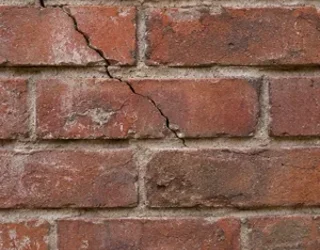 The visual crack guide
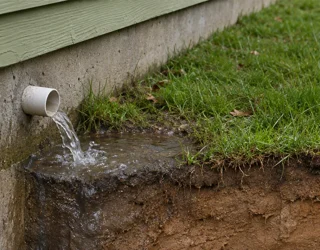 Water & hydrostatic pressure
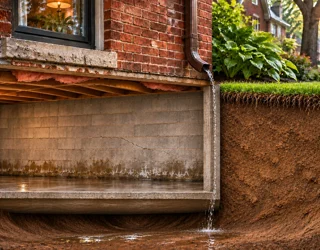 Repair options compared
THE SEQUENCE
Do the decision work in the right order.
- Stabilize urgent hazards and active water safely.
- Document the pattern, history, drainage and prior work.
- Identify the likely force or failure mechanism and the limits of the assessment.
- Define the objective: water control, structural bonding, lateral restraint, load transfer, lift, stabilization—or a combination.
- Compare complete scopes, exclusions, permits, monitoring and records.
METHOD MATRIX
What each repair can—and cannot—do.
See illustrated examples of injection, wall braces, carbon fiber and pier underpinning
| Method | Best matched to | Does not solve by itself | Evidence to request |
|---|---|---|---|
| Surface seal or patch | Limited nonmoving seepage or surface defects | Stopping water pressure or stabilizing movement | Preparation, product limits and drainage diagnosis |
| Polyurethane injection | Water control through suitable cracks and joints | Restoring structural capacity by itself | Crack condition, moisture compatibility and warranty |
| Epoxy injection | Bonding suitable, stable cracks where structural continuity is intended | Actively moving cracks or unresolved causes | Engineer-defined objective, resin data and injection record |
| Carbon-fiber FRP | Designed reinforcement of eligible concrete or masonry walls | Large displacement, unsupported connections or settlement | System report, design, substrate and installation details |
| Steel beams or braces | Interior restraint where the floor system and slab can support the design | Water control or automatic straightening | Spacing, connections, corrosion protection and design |
| Wall anchors or tiebacks | Resisting inward wall movement where exterior access and soil conditions allow | Every property line, utility or access condition | Anchor layout, exterior limits and engineer/permit review |
| Helical or push piers | Transferring eligible foundation loads to competent bearing | Bowing walls, leaks or slabs without load-path analysis | Design loads, installation logs, brackets and monitoring |
| Drainage and sump system | Collecting and safely discharging water around or below the foundation | Repairing a structurally unstable wall | Discharge path, pump capacity, backup and service access |
ESTIMATE CHECK
Make every bidder answer the same questions.
- What measured condition is the repair addressing?
- What alternative explanations or repairs were considered?
- Is the goal stabilization, correction, water control or cosmetic improvement?
- Who designed the spacing, loads, connections and material system?
- What permits, inspections or sealed documents apply?
- What will be recorded during installation?
- What is excluded, and what could create a change order?
- What does the warranty cover—and who must maintain drainage or pumps?
SOURCE TRAIL
Technical references
These are starting references, not a project design. Product eligibility, code acceptance and installation conditions must be checked for the specific home.
REFERENCEAmerican Concrete InstituteRAP-1: Structural crack repair by epoxy injection
Explains repair objectives, applicability, material selection and the need to correct the cause first.
REFERENCEICC Evaluation ServiceEvaluation Report ProgramExplains how technical evaluation reports document code compliance and conditions of use for proprietary products.
REFERENCEBuilding America Solution CenterFooting drain pipeReference for drainage collection and discharge as a distinct repair category.